Ingest the system
System design, sensor suite, robot software stack, simulation scenes, and the standards that apply to your market.
Design docs · ROS 2 · SysML · CAD · sim scenes
Saphira generates the hazard analysis from your system, derives the safety requirements, runs the scenarios in simulation, and produces the certification evidence—as one closed loop that re-runs on every design change and every model checkpoint.
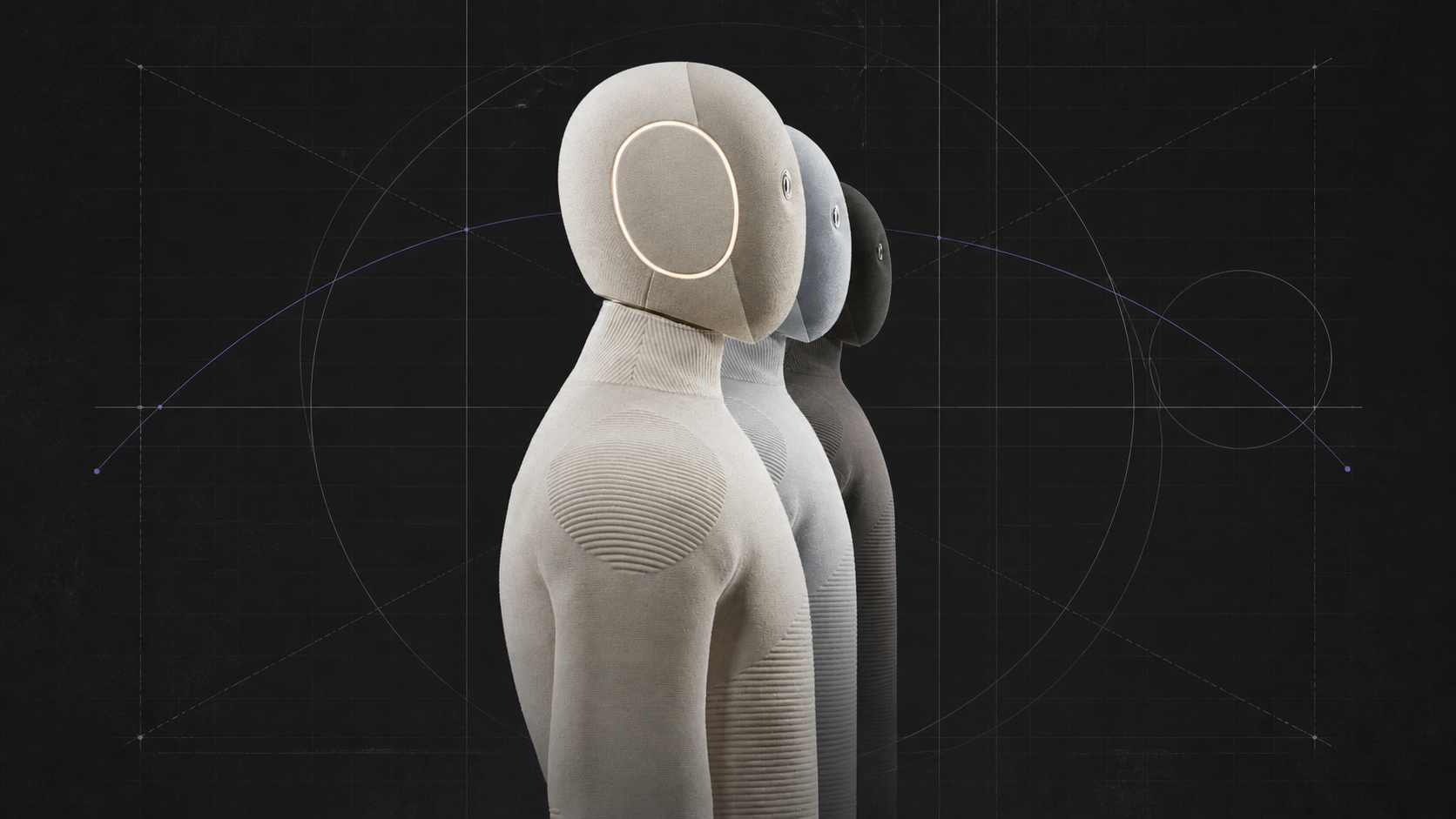
1X today. 100 million humanoids tomorrow. Read the 1X humanoid case study

Six stations between a system and a validated system
Safety validation is normally a sequence of documents produced by hand, months apart, by people reading each other's spreadsheets. Saphira runs it as a production line, where each station's output is the next station's input and the last station feeds the second.
System design, sensor suite, robot software stack, simulation scenes, and the standards that apply to your market.
Design docs · ROS 2 · SysML · CAD · sim scenes
HARA, TARA, and FMEA derived from the actual system under test—including video off physical robots—instead of a template someone adapted from a previous program.
HARA · TARA · FMEA · risk matrix
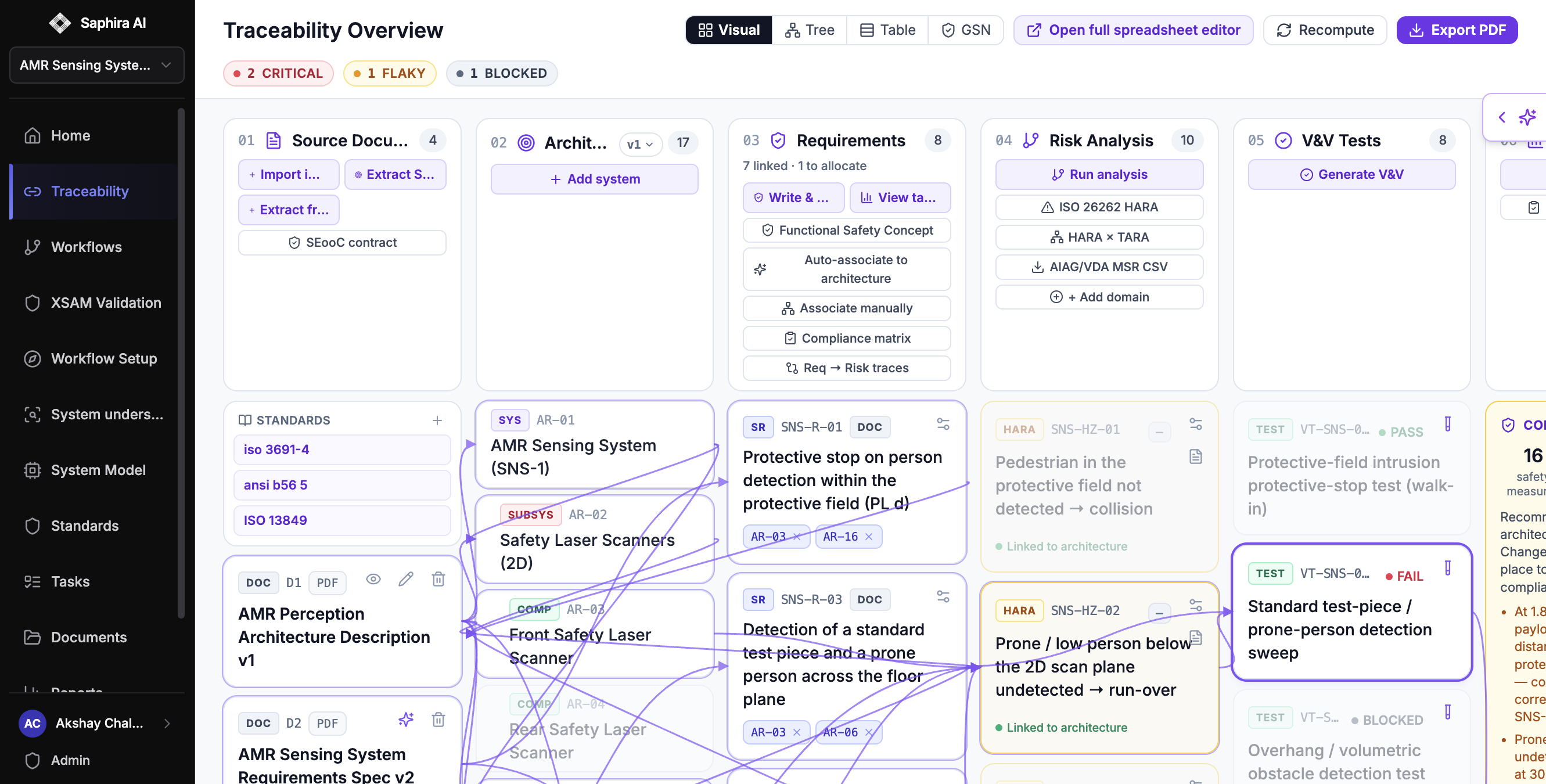
Every hazard produces requirements with acceptance criteria, allocated to the architecture and traceable in both directions.
Safety goals · requirements · allocation
Scenarios are generated per requirement and orchestrated in simulation, so coverage is measured against the hazards you have to defend—not against a test list someone wrote by hand.
Simulation orchestration · scenario coverage
Results assemble into a traceable safety case with the verification record attached to every requirement, ready for TÜV, UL, or CE review.
Safety case · V&V record · audit trail
Field incidents and deployment data return to the hazard analysis, so the next release is validated against what actually happened in the world.
Incident analysis · fleet feedback
A design change, a new model checkpoint, or an incident in the field re-enters at station 02 and the whole line re-runs. Validation stops being a gate you pass once and becomes a property the system holds continuously.
Why the factory matters more than any one artifact
Adopting a new compute platform, a new sensor, or a new control stack is expensive because everything downstream has to be re-validated by hand. When validation is automated, the cost of changing your architecture collapses—which matters in a field where nobody yet knows which architecture wins.
A passing test suite tells you the tests passed. Saphira ties every scenario back to the hazard it exists to defend, so coverage is a statement about the risks in your system rather than about the work your team happened to do.
Because evidence accumulates as the line runs, the certification package is never a six-month reconstruction of decisions made a year earlier. It is current as of the last run, and it says which requirement each result belongs to.
The workflows the line is built from
Each one runs on its own if that is where you need to start, and they compose into the full loop.
Track standards coverage continuously and identify certification gaps before final review.
Generate and maintain functional safety analyses with traceable links across requirements and evidence.
Build cybersecurity workflows that connect threat analysis, controls, and verification artifacts.
Create structured risk assessments and keep them synchronized with product and design changes.
Manage verification and validation activities with evidence-ready outputs for audits and certification.
Analyze incidents quickly and tie findings back to requirements, mitigations, and future prevention steps.
Saphira AI · Competitive Positioning
| Capability | Saphira | Incumbents(Medini / Jama) | Systems-Engineering Tools(SysML / MBSE) | Runtime Safety(E-stops / safety controllers) |
|---|---|---|---|---|
| Live assurance graph | — | |||
| AI-generated HARA / FMEA / TARA | Manual | Manual | — | |
| Change impact analysis | Partial | Partial | — | |
| CI/CD integration | — | |||
| Regulator-ready evidence | Manual | — | ||
| Runtime enforcement hardware | Integrates | |||
| Time to first artifact | Days | Months | Months | — |
Runtime safety systems enforce limits in the field. Saphira is the intelligence and evidence layer that decides what's safe and proves it—complementary layers, not competing ones.
Built for systems that move around people
Scenario coverage has to be argued, not asserted. Saphira ties each simulated scenario to the hazard and SOTIF concern it addresses, so the residual risk argument holds up under ISO 26262 and ISO 21448 review.
Learned policies change faster than any manual safety process can re-certify them. Re-running the line on every checkpoint is the only way to keep a safety case current against a model that keeps moving.
Every new cell, payload, or site is a new risk assessment. Saphira reuses the hazard model across deployments so each installation is a re-run rather than a restart.
Why people love using Saphira to get more done.
"I am very excited to continue this journey together with your team! We at RobCo highly value our partnership and the opportunities it presents for future certification challenges. Looking forward to our continued success."

"Saphira is an intriguing tool that should streamline data-focused gap analyses and help enable quick wins when optimizing systems engineering development."

"Akshay and the Saphira team are building a critical and useful tool to enhance the quality, consistency, and ease of creating safety traceability. Their continued work with safety experts across many fields and dedication to designing out the monotonous aspects of regulatory documentation has the ability to responsibly bring safety up to the fast pace of the startup world"
Compliance is an output of the factory
Certification is what the line produces on the way to a validated system, not the reason the line exists. The analyses, traceability, and test evidence assemble into the package each regime asks for.
Saphira is a member of the NVIDIA Halos AI Systems Inspection Lab, and our safety engineers review generated analyses before they reach an assessor. Read the security and compliance overview for how the platform is deployed and reviewed.
Latest Insights
Stay updated with our latest articles on safety compliance and industry best practices. Read more

1X today, 100 million humanoids tomorrow: why machines that never stop changing need living risk models and evidence that keeps up

How Saphira helped 1X Technologies de-risk their next-gen humanoid with investor- and partner-ready safety artifacts

How RobCo leveraged Saphira AI's intelligent compliance tools to achieve ISO 10218-1 certification in record time.
Bring a robot, a vehicle, or a model checkpoint. We'll run it through the factory—hazard analysis, requirements, simulated scenarios, evidence—and show you what comes out the other end.
Led by Hardware & AI Experts
Saphira's team brings deep expertise in AI solutions for hardware compliance from Amazon, Tesla, and Apple