
Every autonomous machine that leaves the lab eventually hits the same wall: someone—a customer, an insurer, a regulator—asks you to prove it's safe.
For a traditional product, that question came once, at certification, against a frozen design. For an autonomous machine, it never stops coming. The design ships weekly. The software changes daily. The operating environment is the open world. And the proof has to keep up.
That's not a compliance problem. It's a risk engineering problem, and it's why we built Saphira.
The tooling gap
The tools the industry inherited were built for a different era:
- Incumbent safety suites assume a design that's finished. Every change means re-running manual analyses—HARAs, FMEAs, TARAs—by hand, weeks at a time.
- Systems-engineering tools model the system beautifully, but the safety analysis still lives in someone's head (or someone's spreadsheet).
- Runtime safety hardware—e-stops, safety controllers—enforces limits in the field, but can't tell you what the limits should be or prove they're sufficient.
Each of these layers matters. None of them answers the question autonomous machines get asked constantly: given everything that just changed, is this machine still safe—and can you show me the evidence?
What a risk engineering layer looks like
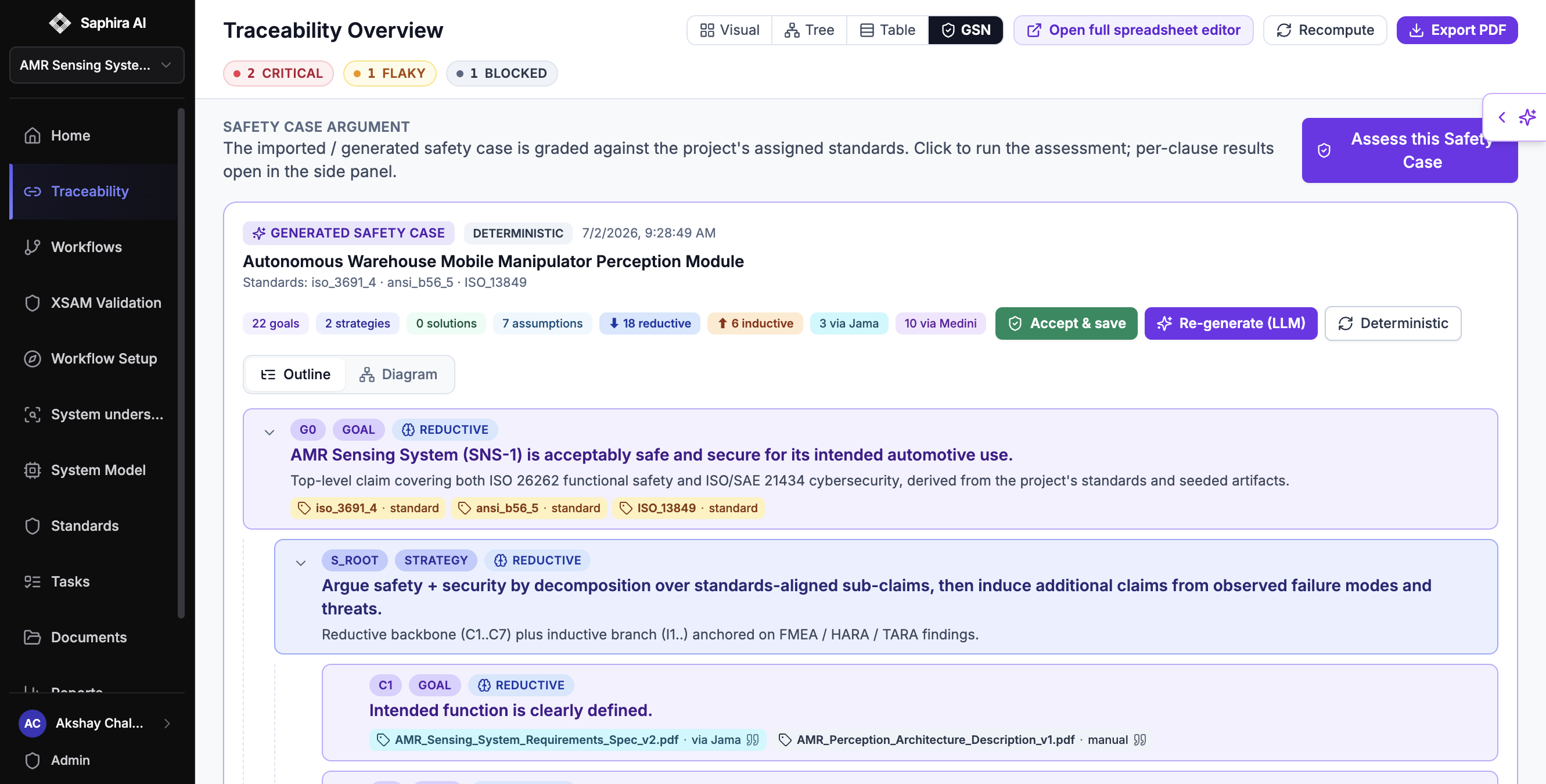
Saphira sits between your system design and everyone who needs proof. It turns design documentation into living risk models—HARAs, TARAs, and FMEAs that regenerate as the design changes—and maintains a live assurance graph linking every requirement, hazard, mitigation, and test to the evidence behind it.
When a design changes, the impact propagates. When a customer or regulator asks, the artifact already exists. When runtime systems need limits to enforce, the analysis that justifies those limits is versioned and traceable.
This is already working in production
This isn't a thesis—it's how our customers ship today.
The clearest example is 1X Technologies. Bringing a humanoid into everyday environments is the hardest version of this problem: legged locomotion, open-world operation, no settled standard to certify against. 1X used Saphira to evaluate high-risk operational scenarios, produce investor- and partner-ready safety artifacts, and give engineering, product, and leadership a shared safety language—without slowing development.
The same pattern holds across the industry, from automotive programs recompeting incumbents on their home turf to robotics teams like RobCo compressing ISO 10218 timelines from months to days.
The 100-million-humanoid question
Here's the part that matters for where this is all going.
If the humanoid forecasts are even directionally right—tens of millions of general-purpose robots working alongside people—then every one of them will need a continuously maintained answer to "is it safe, and can you prove it?" No army of consultants scales to that. No frozen-design toolchain survives it. The only thing that scales is a risk engineering layer that regenerates the analysis and the evidence as fast as the machines change.
1X today. 100 million humanoids tomorrow. The companies deploying autonomous machines at scale are already building on that layer. If you're facing the proof question—from a customer, an insurer, or a regulator—talk to us.